
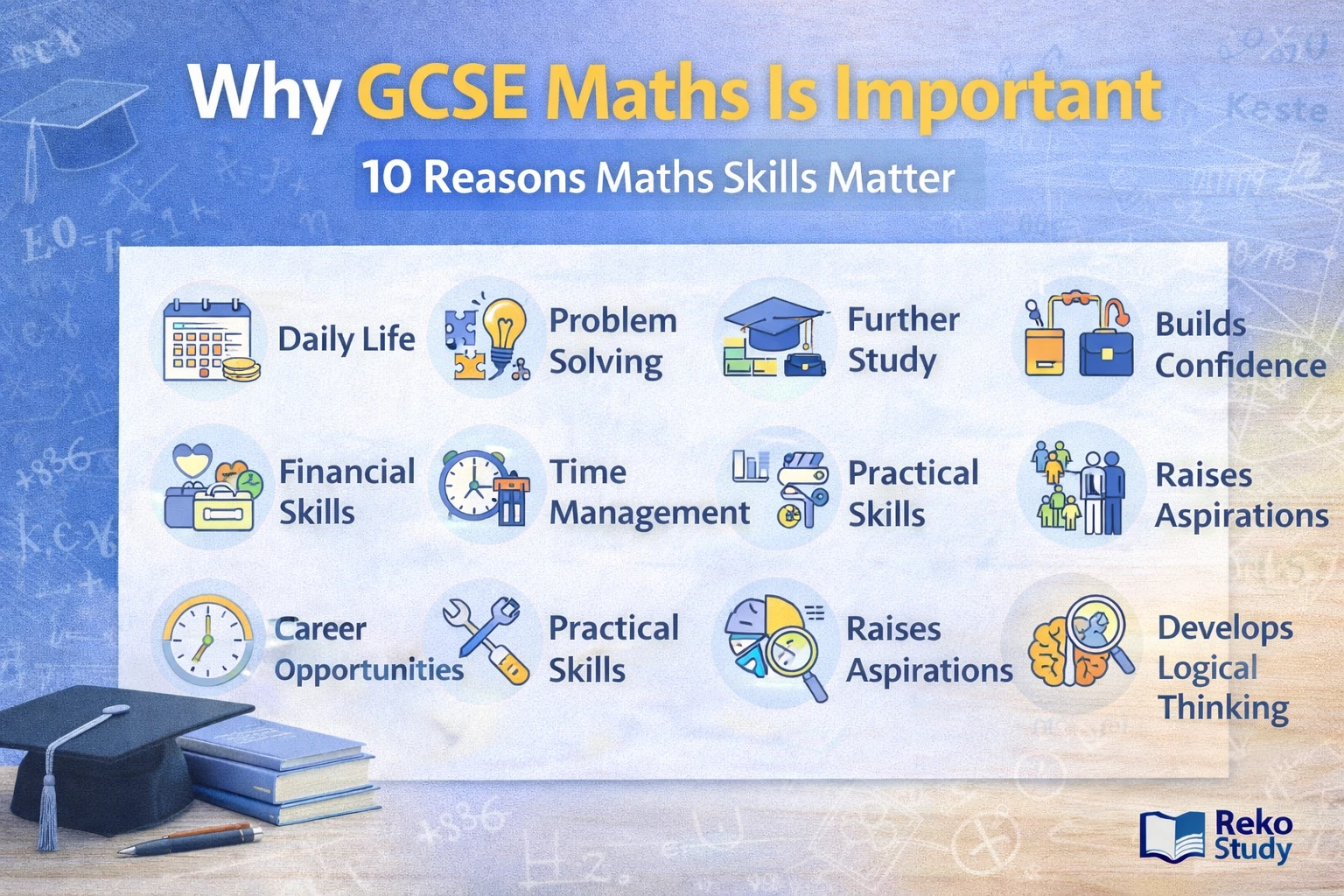
Many students see GCSE Maths as something they need to pass and then leave behind. In reality, the skills learned through maths continue to matter long after the exam is over.
Maths helps with everyday decisions, personal finance, further education, careers, technology, and problem solving. It is not only about numbers and formulas. It is about learning how to think clearly, make sensible choices, and understand the world around you.
Here are ten reasons why GCSE Maths skills matter beyond school.
1. Maths Helps in Everyday Life
Maths appears in daily life more often than many students realise. Shopping, cooking, travelling, budgeting, and measuring all involve maths.
For example, you use percentages when working out discounts, ratios when changing a recipe, and measurements when decorating a room. Even splitting a bill or comparing prices relies on number skills.
This is why topics like Number and Ratio and Proportion are so useful beyond the exam.
2. Maths Supports Personal Finance
Maths is essential for managing money. Understanding percentages, interest rates, tax, savings, loans, and bills helps people make better financial decisions.
GCSE Maths topics such as percentage change, compound interest, and best value are directly linked to real life. They help you compare deals, understand repayments, and avoid costly mistakes.
Useful topics include percentage change and best value.
3. Maths Opens Doors in Education
A pass in GCSE Maths is often required for sixth form, college courses, apprenticeships, and university applications. Without it, students may need to resit before moving forward.
Higher grades are especially important for subjects such as Maths, Physics, Chemistry, Computer Science, Economics, and Engineering.
This makes GCSE Maths more than just one subject. It is a qualification that can affect future study options.
4. Maths Is Essential for STEM Careers
Science, technology, engineering, and mathematics careers all rely heavily on maths.
Scientists use maths to measure, compare, and analyse results. Engineers use calculations to design safe and effective structures. Programmers use logic, algorithms, and data. Technology careers often depend on algebra, statistics, and problem solving.
For students interested in STEM, GCSE Maths is the foundation for more advanced study.
5. Maths Matters in Non-STEM Careers Too
Maths is not only useful for scientists and engineers. Many non-STEM careers also require strong number skills.
Business, healthcare, retail, construction, design, hospitality, psychology, and finance all involve maths in some form. This might include budgets, measurements, statistics, stock control, graphs, or data interpretation.
Even if a student does not plan to study maths further, GCSE Maths skills remain valuable in many career paths.
6. Maths Helps You Understand Data
Modern life is full of data. News reports, social media, advertising, health information, and politics often use statistics, percentages, graphs, and averages.
Maths helps people judge whether information is accurate or misleading. For example, understanding percentages makes it easier to question dramatic claims, while statistics helps with interpreting charts and surveys.
Students can strengthen these skills through Statistics and Probability.
7. Maths Builds Problem-Solving Skills
One of the biggest benefits of maths is the way it trains the brain. Maths teaches students to break problems into steps, spot patterns, test methods, and check whether answers make sense.
These skills are useful far beyond exams. They help with planning, decision-making, work tasks, and everyday challenges.
Learning maths also builds resilience. Difficult questions teach students how to keep going, try another method, and learn from mistakes.
8. Maths Is Behind Technology
Technology depends on maths. Apps, websites, search engines, video games, maps, artificial intelligence, and data systems all use mathematical ideas.
Programming uses logic and structure. Graphics use geometry. Algorithms use patterns and data. Artificial intelligence relies heavily on statistics and probability.
For students growing up in a digital world, maths helps them understand the systems they use every day.
9. Maths Improves Decision-Making
Good decisions often involve comparing options. Maths helps people estimate, calculate, and judge whether something is reasonable.
This could mean choosing the best phone contract, comparing travel costs, understanding risks, or deciding whether a deal is really worth it.
Instead of guessing, maths allows people to make decisions based on evidence.
10. Maths Builds Confidence and Independence
Maths is a life skill. It helps people feel more confident managing money, understanding information, and solving problems independently.
Passing GCSE Maths can also give students a strong sense of achievement. It proves that progress is possible through practice, effort, and persistence.
This confidence can carry into future study, work, and everyday life.
Conclusion
GCSE Maths matters because it gives students skills they will use long after school. It supports education, careers, technology, finance, decision-making, and everyday independence.
Even students who do not plan to study maths further benefit from the problem-solving and logical thinking it develops.
You can explore the main GCSE Maths topic areas here: GCSE Maths topics.
If you need support building confidence in maths, you can book a free GCSE Maths intro session to create a personalised plan.