
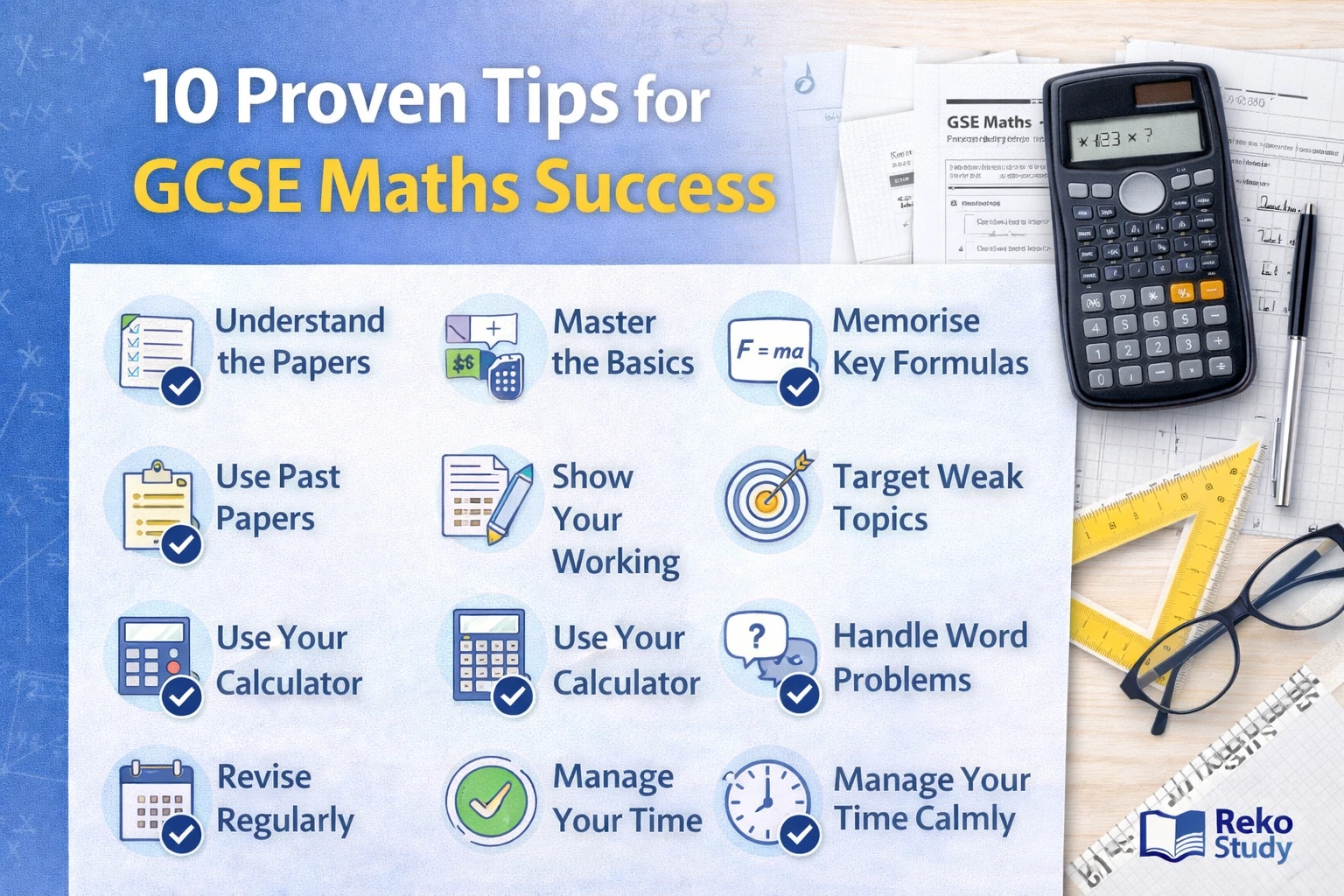
GCSE Maths is one of the most important qualifications you will take at school. Whether you are sitting Foundation or Higher Tier, the exam can feel challenging because it covers many different skills, from basic number work to multi-step problem solving.
The good news is that passing GCSE Maths is not about natural talent. It comes from using the right strategies, practising consistently, and learning how to approach exam questions with confidence.
Here are ten practical tips to help you prepare effectively and improve your chances of success.
1. Know the Exam Structure
GCSE Maths usually has three papers:
- Paper 1: Non-calculator
- Paper 2: Calculator
- Paper 3: Calculator
Each paper is equally important. Foundation Tier covers grades 1 to 5, while Higher Tier covers grades 4 to 9.
Knowing the structure helps you revise properly. You need strong non-calculator skills for Paper 1 and confident calculator use for Papers 2 and 3.
2. Master the Basics First
Many GCSE Maths marks depend on core skills. Before focusing on harder topics, make sure you are confident with:
- fractions, decimals and percentages
- BIDMAS
- negative numbers
- basic ratio and proportion
Weak basics make harder questions much more difficult. Strong foundations make the whole paper easier.
Start here: Number topics
3. Learn Key Formulas
Some formulas are given in the exam, but many need to be remembered. Important formulas include Pythagoras’ theorem, trigonometric ratios, the quadratic formula, and area and volume formulas.
Do not leave formula revision until the final week. Practise recalling and applying formulas regularly.
Useful topics include:
4. Practise Past Papers Early
Past papers are one of the best ways to prepare. They show you the style of questions, how topics are mixed, and how marks are awarded.
Start past papers early, not just before the exam. After each paper, review mistakes carefully and reattempt the questions you got wrong.
This helps you understand patterns and build exam confidence.
5. Show Your Working
In GCSE Maths, you can gain marks for your method even if your final answer is wrong. These are called method marks.
Always write down the important steps. Clear working helps the examiner see your thinking and helps you check your own answer.
This habit can make a big difference to your final grade.
6. Improve Weak Topics
Many students spend too much time practising topics they already enjoy. Real progress comes from working on weaker areas.
Identify topics where you lose marks, then practise them regularly until they improve.
Good places to start are:
7. Use Your Calculator Properly
Your calculator is important for Papers 2 and 3, but only if you know how to use it accurately.
Practise using brackets, fractions, powers, square roots, and trigonometric functions. Avoid rounding too early, and always check that your calculator is in the correct mode for trigonometry.
A calculator should save time, not create mistakes.
8. Learn How to Tackle Word Problems
Word problems can feel difficult because the maths is hidden inside a written situation.
Use this method:
- Read the question carefully
- Identify what you need to find
- Underline key information
- Turn the words into maths
- Check whether the answer makes sense
Common word-problem topics include speed, distance and time, sharing in a ratio, and percentage change.
9. Revise Regularly, Not Last Minute
Maths improves through regular practice. Short daily sessions are usually better than long cramming sessions before the exam.
Even 20–30 minutes a day can make a big difference over time. Mix topics during revision so you become comfortable switching between different question types.
Browse all topics here: GCSE Maths topics
10. Stay Calm and Manage Your Time
Many students lose marks because they spend too long on one question. A useful guide is about one minute per mark.
If you get stuck, write down any useful working, move on, and return later if you have time. Try to leave a few minutes at the end to check answers, units, rounding, and calculator entries.
Good time management can reduce stress and help you collect marks across the whole paper.
Conclusion
Passing GCSE Maths is not about luck. It comes from building strong basics, practising regularly, showing clear working, and learning how to manage the exam calmly.
Small improvements add up. If you revise consistently and focus on your weaker topics, you can make real progress before exam day.
If you need extra support, you can book a free GCSE Maths intro session to create a personalised revision plan.