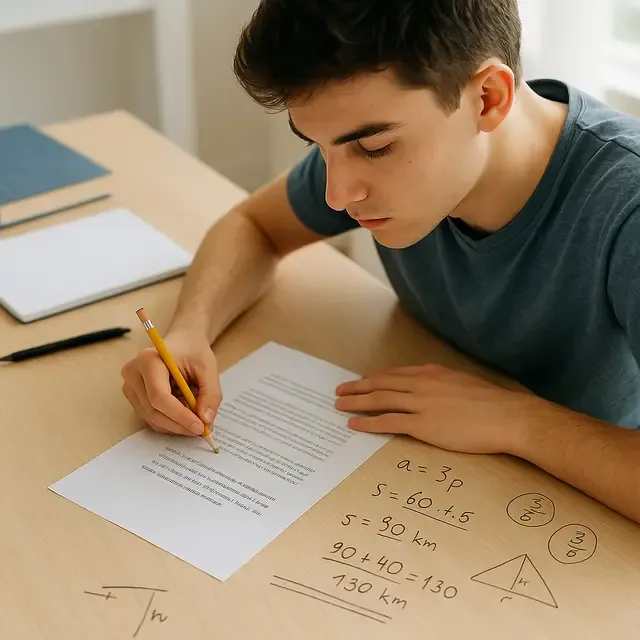
Word problems are often the part of GCSE Maths that students find the most difficult. Even confident learners can feel unsure when faced with a long block of text hiding the maths inside. The challenge is not just calculation, but understanding the situation, deciding what is relevant, and choosing the correct method.
The good news is that word problems are not random or unpredictable. They follow clear patterns. Once you learn how to break them down step by step, they become much easier to manage.
Why Word Problems Feel Difficult
Word problems combine reading and maths. Instead of giving you a clear calculation, the question describes a situation and expects you to extract the maths from it.
This creates two main challenges:
- identifying which information is important
- turning the words into mathematical steps
Students often know the maths, but struggle with this translation step. The key is to treat word problems as normal maths questions written in a different format.
Read the Question Carefully
Many mistakes happen because students rush. Word problems often include specific instructions such as “estimate”, “to two decimal places”, or “give your answer as a fraction”. Missing these can cost marks even if the method is correct.
Take a few seconds to read the question twice and underline key information. Look especially at the final sentence — this usually tells you exactly what you need to find.
Identify the Goal
Before starting any calculations, ask yourself:
What is the question asking me to find?
For example:
- Journey problems → distance, speed or time
- Money problems → total cost, profit or percentage change
- Shape problems → area, perimeter or volume
Knowing the goal makes the solution much clearer.
Turn Words into Maths
The key skill in word problems is translating language into maths.
Examples:
- “three times as many” → multiply by 3
- “shared equally” → divide
- “per hour” → rate (division)
Writing a quick equation, sketch, or diagram can make the problem easier to understand.
👉 Practise core topics here: GCSE Maths topics
Break the Problem into Steps
Word problems often involve more than one step. Trying to do everything at once leads to confusion.
Instead:
- write down what you know
- complete one step at a time
- use each answer to move to the next step
This keeps your working clear and helps you pick up method marks.
Recognise Common Question Types
Most word problems follow familiar patterns. Recognising these helps you choose the right method quickly.
- Speed, distance, time → use formulas
- Ratio → sharing and scaling
- Probability → outcomes and fractions
- Geometry → area, volume, angles
- Percentages → increase, decrease, interest
👉 For example, practise: Speed, distance and time Ratio Probability
Show Your Working
Word problems often carry several marks. You can still gain marks even if the final answer is incorrect, as long as your method is clear.
Write each step clearly. This helps both the examiner and you when checking your work.
Check Your Answer Makes Sense
Because word problems use real-life situations, your answer should be realistic.
Ask yourself:
- Is the answer too large or too small?
- Does it match the context?
- Are the units correct?
A quick estimate can often catch mistakes.
Practise Regularly
Word problems improve with practice. The more you see them, the easier they become.
Short daily practice is more effective than cramming. Over time, you will start to recognise patterns and feel more confident.
👉 Practise with exam-style questions here: GCSE Maths topics
Build Confidence Over Time
At first, word problems may feel difficult. But with consistent practice, they become familiar. You will start to recognise the structure, understand the language, and apply the correct methods more quickly.
Confidence comes from repetition and having a clear approach.
Conclusion
Word problems are simply maths questions written in a different way. By reading carefully, identifying the goal, translating words into maths, and working step by step, you can approach them with confidence.
With regular practice and clear methods, word problems can become one of your strongest areas in GCSE Maths.
👉 If you want extra support, you can book a free GCSE Maths intro session to build a personalised plan.