
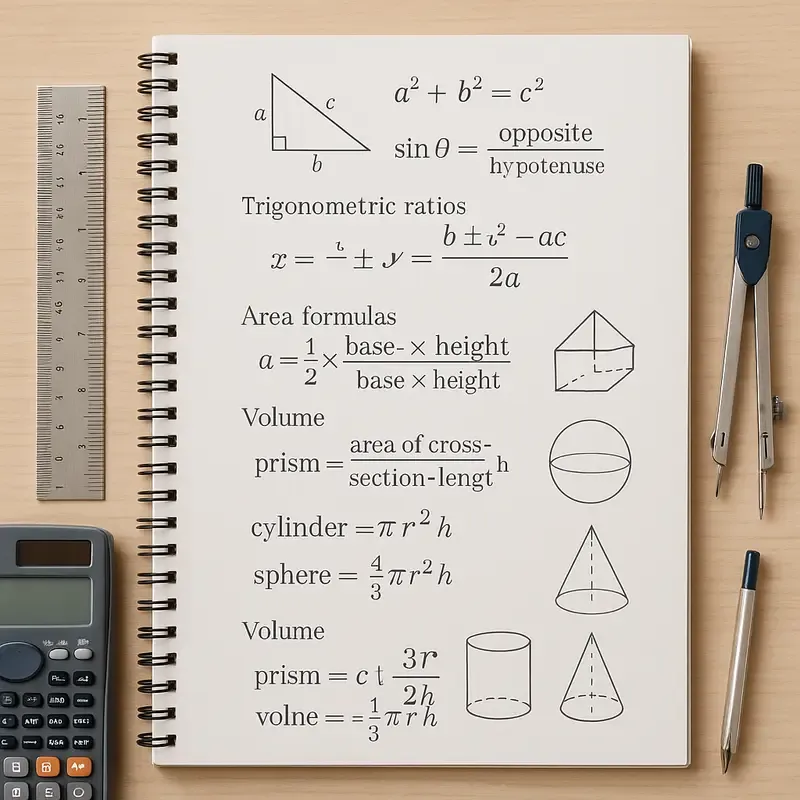
Formulas are at the heart of GCSE Maths. They allow you to solve problems quickly and efficiently, from calculating areas and volumes to solving equations and working with probability.
Some formulas are given in the exam, but many are not. This means students must not only memorise them, but also understand when and how to use them. Forgetting a key formula can turn a simple question into a difficult one.
This guide covers the most important GCSE Maths formulas, explains what they are used for, and shows how to learn them effectively.
Why Formulas Matter
Formulas are tools. Knowing them helps you recognise what a question is asking and apply the correct method straight away.
For example, recognising a right-angled triangle allows you to use Pythagoras’ theorem immediately. Recognising a quadratic equation tells you to factorise or use the quadratic formula.
Strong students do not just memorise formulas — they practise applying them in different situations.
👉 You can practise formula-based topics here: GCSE Maths topics
Pythagoras’ Theorem
Pythagoras’ theorem is used in right-angled triangles:
\( a^2 + b^2 = c^2 \)
It allows you to find a missing side when the other two are known.
👉 Practise here: Pythagoras’ theorem
Trigonometric Ratios
The three main trigonometric ratios are:
\( \sin\theta = \frac{\text{opposite}}{\text{hypotenuse}} \)
\( \cos\theta = \frac{\text{adjacent}}{\text{hypotenuse}} \)
\( \tan\theta = \frac{\text{opposite}}{\text{adjacent}} \)
These are used to find missing sides or angles in right-angled triangles. A useful memory aid is SOHCAHTOA.
👉 Practise here: Trigonometry
The Quadratic Formula
For equations of the form \( ax^2 + bx + c = 0 \), the quadratic formula is:
\( x = \frac{-b \pm \sqrt{b^2 - 4ac}}{2a} \)
This formula always works, even when factorising is not possible.
👉 Practise here: Quadratic equations
Area Formulas
- Triangle: \( \tfrac{1}{2} \times \text{base} \times \text{height} \)
- Parallelogram: \( \text{base} \times \text{height} \)
- Trapezium: \( \tfrac{1}{2}(a+b)h \)
- Circle: \( \pi r^2 \)
👉 Practise here: Geometry and measures
Volume Formulas
- Prism: area of cross-section × length
- Cylinder: \( \pi r^2 h \)
- Sphere: \( \tfrac{4}{3}\pi r^3 \)
- Cone: \( \tfrac{1}{3}\pi r^2 h \)
- Pyramid: \( \tfrac{1}{3} \times \text{base area} \times h \)
Surface Area Formulas
- Cuboid: \( 2lw + 2lh + 2wh \)
- Cylinder: \( 2\pi r^2 + 2\pi rh \)
- Sphere: \( 4\pi r^2 \)
- Cone: \( \pi r^2 + \pi rl \)
Circle Theorems
Important rules to remember include:
- Angle in a semicircle = 90°
- Angle at centre = 2 × angle at circumference
- Angles in the same segment are equal
- Opposite angles in a cyclic quadrilateral = 180°
- Tangent is perpendicular to radius
👉 Practise here: Circle theorems
Probability and Statistics
- \( P(\text{not }A) = 1 - P(A) \)
- Mean: \( \frac{\sum fx}{\sum f} \)
- \( P(A \cap B) = P(A) \times P(B) \) (independent)
- \( P(A \cup B) = P(A) + P(B) \) (mutually exclusive)
👉 Practise here: Statistics
How to Memorise Formulas
Memorising formulas becomes easier when combined with practice.
- Write formulas out regularly
- Use flashcards for quick recall
- Apply formulas in exam-style questions
- Revisit them frequently instead of cramming
The key is repetition with understanding. The more you use a formula, the more natural it becomes.
Conclusion
Formulas are essential for success in GCSE Maths. They allow you to solve problems efficiently and unlock marks across many topics.
The goal is not just to memorise them, but to recognise when to use them and apply them confidently.
With regular practice and consistent revision, formulas will become second nature, helping you approach your exam with confidence.
👉 Explore all topics here: GCSE Maths topics
👉 If you need extra support, you can book a free GCSE Maths intro session to build a personalised revision plan.