
For many students, GCSE Maths feels challenging because there is a lot to revise. However, one of the best ways to feel more confident is to understand how the exam is actually structured.
GCSE Maths is not random. The papers follow a clear format, cover predictable topic areas, and award marks in specific ways. Once students understand this structure, revision becomes more focused and exam day feels less stressful.
This guide explains how GCSE Maths is assessed, how the papers are organised, what topics appear, how marks are awarded, and how students can use this knowledge to prepare effectively.
How GCSE Maths Is Assessed
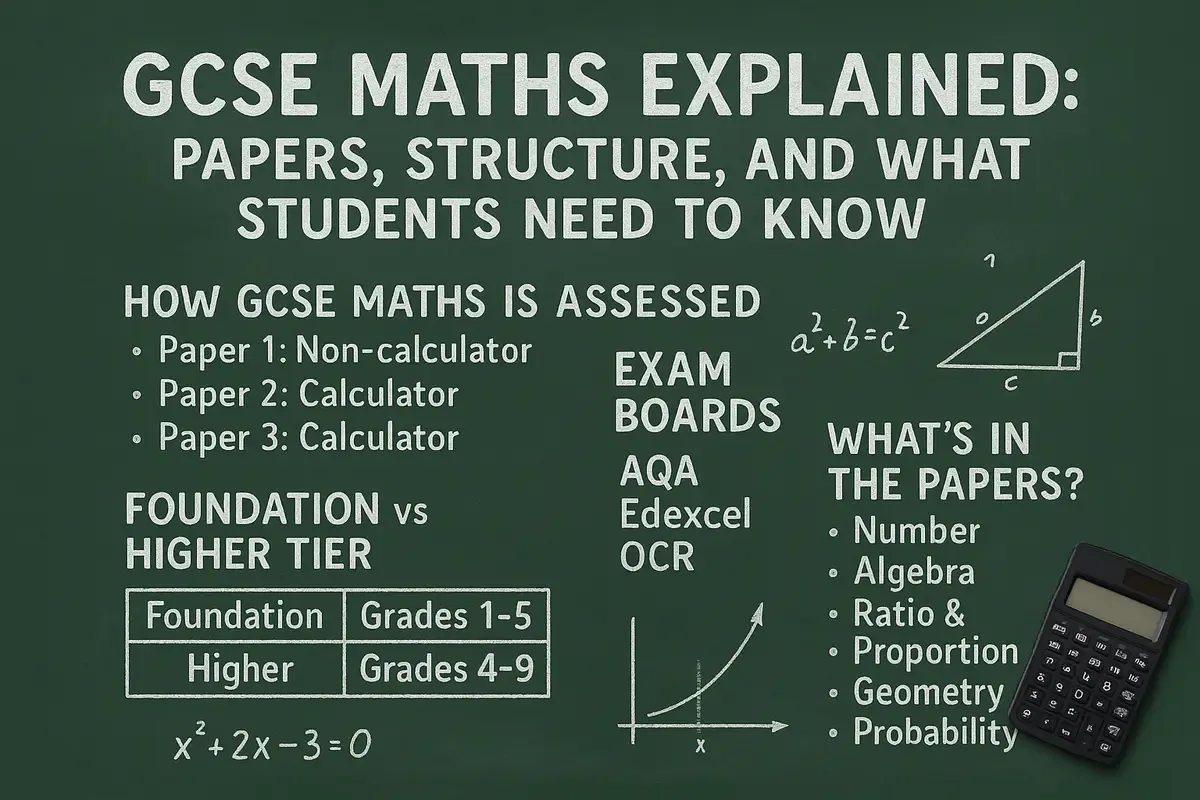
GCSE Maths is usually assessed through three written exam papers taken at the end of the course.
- Paper 1: Non-calculator
- Paper 2: Calculator
- Paper 3: Calculator
Each paper lasts 90 minutes and is worth the same number of marks. This means all three papers are equally important for the final grade.
The non-calculator paper tests whether students can work accurately without relying on technology. This includes arithmetic, fractions, percentages, algebra, estimation, and reasoning.
The calculator papers allow more complex calculations, but they are not automatically easier. They often include multi-step problem solving, graphs, trigonometry, statistics, and questions where students must decide which method to use.
Exam Boards: AQA, Edexcel and OCR
GCSE Maths is offered by several exam boards, including AQA, Edexcel, and OCR. All exam boards follow the same national GCSE Maths content, so the main topics are broadly the same.
The difference is usually in the style of questions. Some papers may use shorter questions, while others may include more worded problem-solving tasks. The layout and wording can also feel slightly different.
For revision, students should mainly practise papers from their own exam board. This helps them become familiar with the exact style they will face. However, using questions from other boards can also be useful because it exposes students to a wider range of wording and problem types.
Foundation and Higher Tier
GCSE Maths is split into two tiers: Foundation and Higher.
- Foundation Tier: grades 1 to 5
- Higher Tier: grades 4 to 9
Foundation focuses on core maths skills and gives students a clear route towards a pass. Higher includes more advanced content and gives access to grades 6, 7, 8, and 9.
The right tier depends on a student’s current level, confidence, mock results, and future plans. Students aiming for A-Level Maths or STEM subjects usually need Higher, while students focused on securing a grade 4 or 5 may be better suited to Foundation.
You can read more about the topic areas in our GCSE Maths sections, including Number, Algebra, and Geometry & Measures.
What Appears in GCSE Maths Papers?
GCSE Maths papers include a mixture of short questions, longer multi-step problems, and reasoning questions. Some questions are direct, while others require students to apply maths in unfamiliar situations.
The main topic areas are:
- Number: fractions, decimals, percentages, standard form, rounding, estimation and calculations
- Algebra: expressions, equations, graphs, sequences, formulae and functions
- Ratio and proportion: ratio, percentages, direct proportion, inverse proportion, rates and scaling
- Geometry and measures: angles, shapes, area, volume, transformations, Pythagoras and trigonometry
- Probability: probability scales, tree diagrams, Venn diagrams and relative frequency
- Statistics: averages, charts, frequency tables, histograms, box plots and scatter graphs
This variety means students should not revise only their favourite topics. A strong revision plan covers all areas, with extra time spent on weaker topics.
Topic Weightings
Not all areas of GCSE Maths carry the same number of marks. The exact weighting can vary slightly between exam boards and tiers, but the general pattern is similar.
- Number: about 25–30%
- Algebra: about 20–30%
- Ratio, proportion and rates of change: about 20–25%
- Geometry and measures: about 15–20%
- Probability and statistics: about 15–20% combined
This shows why Number and Algebra are so important. They appear frequently and also support many other topics. For example, weak fraction skills can affect ratio, probability, algebra and geometry questions.
Students can use the topic weightings to revise strategically. High-weight areas should receive regular practice, but smaller areas should not be ignored because every mark can matter.
How Marks Are Awarded
GCSE Maths marks are not only awarded for final answers. Many questions also give marks for correct methods, clear working, and reasoning.
This is why students should always show their working. Even if the final answer is wrong, a correct method can still earn marks. For example, using the correct formula, setting up an equation properly, or showing a logical step may all be rewarded.
There are usually three main types of marks:
- Method marks: for using the correct process
- Accuracy marks: for getting the correct answer
- Reasoning marks: for explaining or justifying an answer
Clear working gives the examiner evidence of understanding. It also helps students check their own work and spot mistakes before moving on.
Timing in the Exam
Each GCSE Maths paper lasts 90 minutes. Since papers usually contain around 80 marks, a useful guide is roughly one mark per minute.
This does not mean every question should take exactly the same time. Some one-mark questions may take only a few seconds, while longer problems may take several minutes. However, the rule helps students avoid spending too long on one question.
A good exam strategy is:
- answer the questions you can do first
- show working even if you are unsure
- move on if you are stuck
- return to difficult questions at the end
- leave a few minutes for checking
Practising under timed conditions is one of the best ways to improve exam confidence.
Calculator and Non-Calculator Skills
Because GCSE Maths includes both calculator and non-calculator papers, students need both types of skill.
For the non-calculator paper, students should practise mental arithmetic, estimation, fractions, percentages, algebra manipulation and exact values.
For calculator papers, students should practise using brackets, fractions, powers, roots, trigonometric functions and standard form correctly. A calculator is only helpful if the student knows how to enter calculations accurately.
Good revision should include both styles. Students who only practise calculator questions may struggle with fluency, while students who avoid calculator practice may make avoidable input or rounding errors.
How to Prepare Effectively
Understanding the structure of GCSE Maths helps students revise more intelligently. Instead of revising randomly, they can build a plan around the papers, topic areas, and skills required.
A strong revision plan should include:
- regular topic practice
- mixed exam-style questions
- past papers under timed conditions
- reviewing mistakes carefully
- balancing calculator and non-calculator work
Start with core areas such as Number and Algebra, then build towards mixed practice across all topics.
You can also browse the full topic list here: GCSE Maths topics.
Getting Extra Support
Some students understand the topics but struggle with exam technique, timing, or confidence. Others need help identifying weak areas and building a clear revision plan.
Targeted support can make revision more efficient because it focuses on the exact topics and skills the student needs most.
If you would like personalised support, you can book a free GCSE Maths intro session to discuss the best plan for your current level and target grade.
Conclusion
GCSE Maths becomes much easier to prepare for when students understand how the exam is structured. There are three papers, two tiers, clear topic areas, and a consistent system for awarding marks.
Knowing this helps students revise with purpose. They can practise the right topics, manage time more effectively, show working clearly, and prepare for both calculator and non-calculator papers.
GCSE Maths is not designed to be mysterious. With steady practice and a clear understanding of the exam structure, students can build confidence and improve their final result.