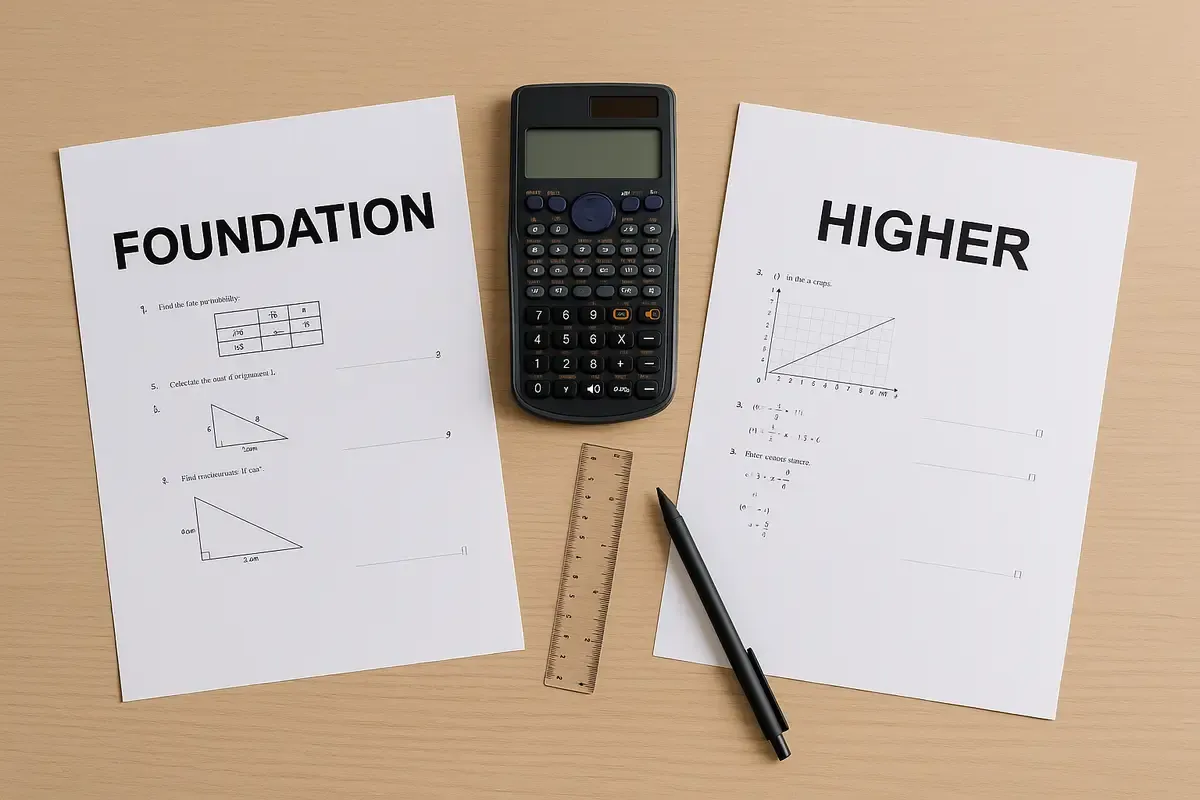
Choosing between Foundation and Higher GCSE Maths is an important decision. It affects the exam papers a student sits, the topics they need to prepare for, and the highest grade they can achieve.
For many students and parents, this choice can feel stressful. Foundation may feel safer, while Higher keeps the door open to top grades. The best choice is not simply the “easy” or “hard” option — it is the tier that gives the student the best chance of success based on their current level, confidence, and future plans.
This guide explains the key differences between Foundation and Higher GCSE Maths, the benefits and risks of each tier, and how to decide which route is right.
What Are GCSE Maths Tiers?
GCSE Maths is split into two tiers: Foundation Tier and Higher Tier. Students do not usually choose this completely on their own. Schools normally decide tier entry based on mock results, class performance, teacher judgement, and the student’s target grade.
The two tiers cover the same broad areas of maths, including Number, Algebra, Geometry & Measures, Probability, Ratio and Statistics. However, the difficulty and depth are different.
Foundation Tier: Grade Range
The Foundation Tier covers grades 1 to 5. This means the highest possible grade on Foundation is a grade 5.
A grade 4 is usually considered a standard pass, while a grade 5 is often seen as a strong pass. For many students, Foundation is the best route because it focuses on securing these important grades without the pressure of the most advanced Higher topics.
The main limitation is that students cannot achieve grades 6, 7, 8, or 9 on Foundation, even if they score very highly.
Higher Tier: Grade Range
The Higher Tier covers grades 4 to 9. This gives students access to the top GCSE Maths grades.
Higher is usually the better route for students aiming for A-Level Maths, science subjects, engineering, computer science, or other pathways where strong mathematical ability is important.
However, Higher papers are more demanding. Students need to be comfortable with more abstract reasoning, multi-step questions, and advanced topics. If a student is not secure enough, Higher can become risky because the easier marks are fewer than on Foundation.
Main Content Differences
Both tiers include core maths skills, but Higher goes further.
Foundation focuses strongly on essential skills such as fractions, decimals, percentages, ratio, basic algebra, graphs, angles, averages, and everyday problem solving.
Higher includes those skills too, but also adds more advanced work such as quadratic equations, functions, vectors, circle theorems, advanced algebra, proof, and more complex problem solving.
This means Higher students need strong foundations first. Without secure basic skills, the advanced topics become much harder.
Advantages of Foundation Tier
Foundation can be the right choice for students who need a clear, structured route towards a pass. The questions are more accessible, and the paper gives students more opportunities to build marks through core skills.
Foundation is especially useful for students who:
- are currently working around grades 2, 3, 4, or low 5
- feel overwhelmed by advanced algebra or abstract questions
- need a grade 4 or 5 for college, apprenticeships, or future training
- want to reduce exam pressure and focus on secure progress
For many students, Foundation is not a “low” option. It is the most sensible route to achieving the grade they need.
Advantages of Higher Tier
Higher is the right choice for students who are already confident with core maths and want access to grades 6 to 9.
Higher may be suitable for students who:
- are consistently working at grade 6 or above
- want to study A-Level Maths or science subjects
- enjoy problem solving and more challenging questions
- need higher grades for future college or career plans
Higher can also be more motivating for students who enjoy challenge. It gives them the chance to stretch their thinking and prepare for more advanced study.
The Risks of Each Tier
Each tier has risks, so the decision needs to be realistic.
The main risk of Foundation is the grade cap. If a student is capable of grade 6 or higher, Foundation may limit their potential.
The main risk of Higher is that the paper may be too difficult if the student is not ready. A student who struggles with Higher content may lose confidence and miss out on marks they could have gained more securely on Foundation.
This is why mock results are so important. They show how a student performs under exam conditions, not just during normal lessons.
How Teachers Decide Tier Entry
Teachers usually look at several pieces of evidence before recommending a tier. These include classwork, homework, topic tests, mock exams, confidence, and attitude to revision.
A student who is consistently achieving secure grade 6 or above is usually a strong candidate for Higher. A student working around grade 3 or 4 may be better placed on Foundation to focus on securing a pass.
For students near the boundary, the decision can be harder. A student working around grade 5 may need careful discussion with teachers to decide whether Higher is worth the risk.
How Students and Parents Can Decide
The best decision comes from looking at three things: current performance, confidence, and future goals.
Ask these questions:
- What grades is the student currently getting in mock papers?
- Do they feel confident with algebra and multi-step problems?
- Do they need a grade above 5 for A-Levels or future courses?
- Would Higher motivate them or overwhelm them?
- Would Foundation give them the best chance of a secure pass?
The aim is not to choose the most ambitious tier automatically. The aim is to choose the tier that gives the student the best realistic outcome.
Try Practice Papers from Both Tiers
One of the best ways to compare the two tiers is to try practice questions from both Foundation and Higher.
If Foundation feels manageable and the student is scoring well, it may be a good route to a strong pass. If Higher feels challenging but still possible, and the student can answer a good number of questions confidently, Higher may be worth considering.
Practice papers also reveal topic gaps. For example, a student may be strong in Number but weaker in Algebra. In that case, focused work on topics like solving linear equations and rearranging formulae can make a big difference.
Foundation or Higher: Which Is Better?
Neither tier is automatically better. Foundation is better for students who need a secure route to grade 4 or 5. Higher is better for students who are ready to aim for grades 6 to 9.
The wrong choice can create unnecessary stress. A student placed on Higher too early may lose confidence. A student placed on Foundation when they are capable of more may feel restricted.
The best tier is the one that matches the student’s current ability and future direction.
Get Support with GCSE Maths
Whichever tier a student takes, success comes from steady practice, clear explanations, and targeted support.
👉 Explore all GCSE Maths topics here: Browse GCSE Maths topics
👉 Strengthen core areas through Number and Algebra.
👉 If you need help deciding between Foundation and Higher, you can book a free GCSE Maths intro session and get a personalised plan.
Conclusion
Choosing between Foundation and Higher GCSE Maths is an important decision, but it does not need to feel confusing. Foundation offers a secure route to grades 1 to 5, while Higher opens access to grades 4 to 9.
The right choice depends on the student’s current level, confidence, mock results, and future goals. Foundation can be the best option for securing a pass, while Higher is suitable for students aiming for advanced study or top grades.
With honest reflection, teacher guidance, and regular practice, students can succeed in GCSE Maths whichever tier they take.