
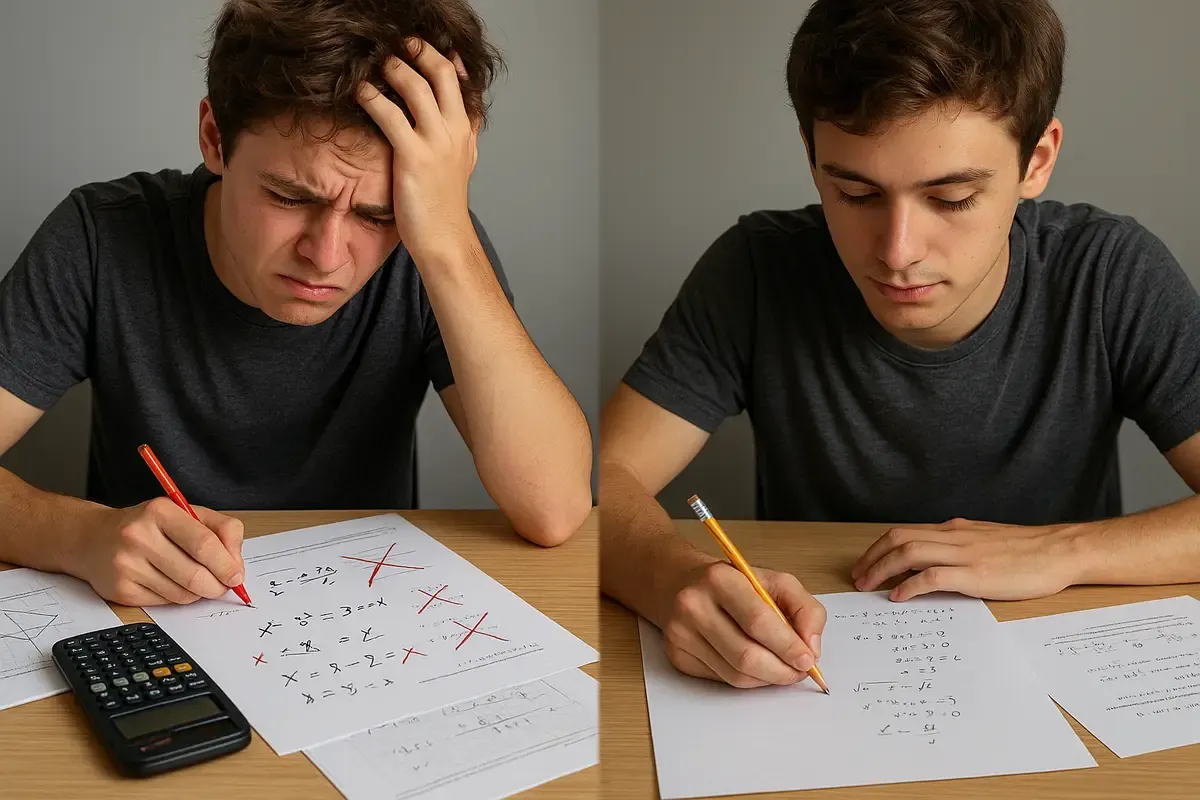
Every year, thousands of students lose marks in GCSE Maths not because they do not understand the subject, but because of small, avoidable mistakes. These errors usually happen under pressure, when time is limited and nerves make it easy to rush or overlook details.
The good news is that most of these mistakes are predictable. Once you know what to watch out for, you can train yourself to avoid them. In this guide, we break down the ten most common GCSE Maths mistakes and show you exactly how to prevent them.
Why Small Mistakes Matter
GCSE Maths is not just about getting answers right — it is about maximising marks. Many questions award marks for method, accuracy, and clarity. This means that even small errors can cost valuable marks across the paper.
A student who avoids common mistakes can often improve their grade without learning any new topics — simply by becoming more careful, structured, and consistent.
1. Not Showing Working
One of the biggest reasons students lose marks is failing to show their working. GCSE Maths awards method marks, meaning you can gain marks even if the final answer is incorrect.
If no working is shown, the examiner cannot award these marks. Always write clear steps, even if the method feels obvious. This also makes it easier to check your work later.
2. Misusing the Calculator
Many students lose marks on calculator papers due to simple mistakes such as incorrect brackets, rounding too early, or using the wrong mode (degrees vs radians).
Keep full accuracy in your calculator until the final step, and only round when the question asks. Practise entering expressions carefully, especially for fractions and powers.
3. Forgetting Key Formulas
Some formulas are provided in the exam, but many are not. Forgetting key formulas can stop you from even starting a question.
You should be confident with formulas such as Pythagoras’ theorem, trigonometric ratios, and the quadratic formula. Regular recall practice is essential.
👉 You can reinforce these through topics like Pythagoras’ theorem and trigonometry.
4. Misreading the Question
This is one of the most common and most costly mistakes. Students often miss key words such as “estimate,” “simplify,” or “give your answer to two decimal places.”
Always read the question carefully and underline important instructions. Before writing your final answer, check that it matches exactly what was asked.
5. Weakness with Fractions, Decimals, and Percentages
These skills appear across almost every GCSE Maths topic. Weakness here causes problems even in algebra, geometry, and probability.
Common issues include incorrect conversions, poor fraction manipulation, and mistakes in percentage change.
👉 Strengthen your foundation using Number topics, where these skills are covered in depth.
6. Mixing Up Negative Numbers and BIDMAS
Errors with negative numbers and the order of operations are very common, especially under time pressure.
Students often forget to apply BIDMAS correctly or confuse subtraction with negative values. Writing steps clearly and using brackets where needed can prevent this.
7. Struggling with Word Problems
Word problems test understanding, not just calculation. Many students rush into solving without fully understanding the question.
Break the problem into steps:
- Identify the key information
- Decide what needs to be found
- Translate the words into maths
- Check the answer in context
👉 Practising topics like ratio and probability can help build confidence with real-world problems.
8. Poor Time Management
Spending too long on one question is a common mistake. This often leads to rushing later questions or leaving them unanswered.
A good guideline is one mark per minute. If you are stuck, move on and return later if time allows.
Practising under timed conditions is essential to develop this skill.
9. Forgetting Units or Labels
Even correct answers can lose marks if units are missing. Always include units such as cm, kg, or m² when required.
In statistics, make sure graphs are labelled clearly and answers are written in full context.
10. Not Checking Answers
Many mistakes can be caught with a quick check. Estimating your answer or re-reading the question can reveal obvious errors.
Even a small correction can make a difference of one or two marks — which can change your final grade.
How to Avoid These Mistakes
The key is not just knowing the mistakes, but actively training yourself to avoid them.
- Practise regularly with exam-style questions
- Track your mistakes in an error log
- Always show full working
- Check your answers before moving on
👉 Start practising GCSE Maths topics here: Browse all GCSE Maths topics
👉 Focus on core areas like Algebra and Number to build a strong foundation.
👉 If you want personalised help, you can book a free GCSE Maths intro session and get a clear plan tailored to your level.
Conclusion
Most GCSE Maths mistakes are not about ability — they are about habits. By improving how you approach questions, manage time, and check your work, you can avoid the traps that cost marks.
Small improvements in accuracy and awareness can lead to big improvements in results. With the right habits and consistent practice, you can walk into your exam confident and prepared.