
GCSE Maths exams are split into two very different types of papers: the Non-Calculator paper and the Calculator paper. Many students prepare for them in the same way, but this is one of the biggest mistakes you can make.
Each paper tests different skills. The non-calculator paper focuses on accuracy, fluency, and mental methods, while the calculator paper focuses on problem solving, interpretation, and efficient use of technology. To perform well, you need a balanced approach that develops both.
This guide explains exactly how to prepare for both papers effectively, with a clear weekly structure and practical strategies you can apply immediately.
Understanding the Difference
The non-calculator paper is designed to test your core mathematical skills. You must be able to work accurately without relying on technology. This includes calculations with fractions, percentages, and algebra, as well as clear reasoning in geometry.
The calculator paper, on the other hand, allows you to use a calculator — but that does not mean it is easier. Instead, the questions often involve more complex problem solving, multi-step reasoning, and interpreting results correctly.
Strong students understand that success comes from mastering both styles, not just one.
A Balanced Weekly Revision Plan
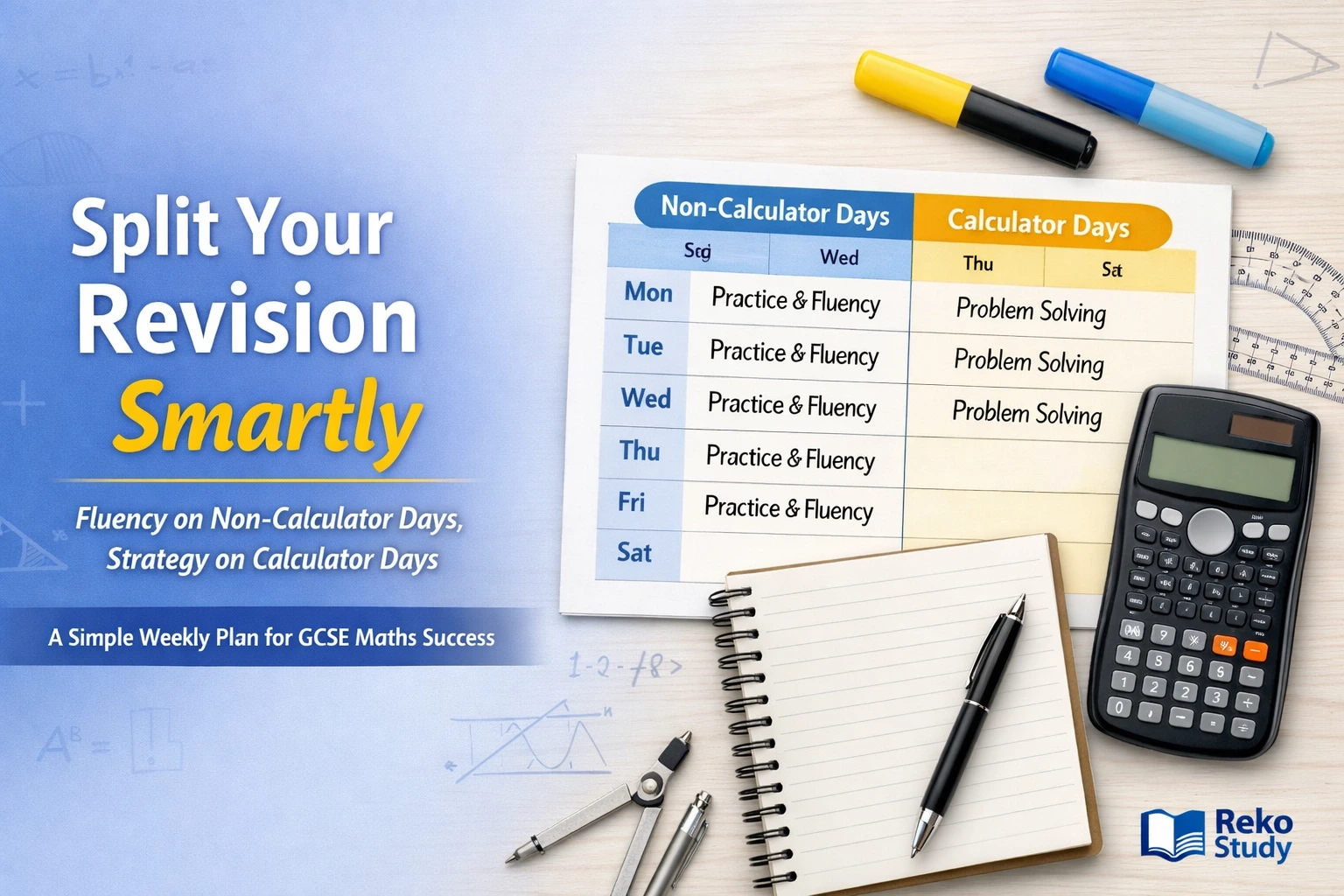
To prepare effectively, you should alternate between non-calculator and calculator skills throughout the week. This ensures you are developing a full range of abilities rather than focusing too heavily on one area.
- Monday (Non-calculator): Fractions, decimals, percentages, estimation and ratio.
- Tuesday (Calculator): Standard form, compound interest, and growth/decay.
- Wednesday (Non-calculator): Algebra skills such as solving linear equations and rearranging formulae.
- Thursday (Calculator): Graphs, quadratics, and statistical diagrams.
- Friday (Non-calculator): Geometry reasoning, including angles and shape properties.
- Saturday (Mixed): Short exam-style questions combining both skills.
- Sunday: Review mistakes and rest.
This structure keeps your revision consistent and ensures that no key area is neglected.
Key Skills for the Non-Calculator Paper
Success in the non-calculator paper comes from fluency and accuracy. You need to be confident performing calculations without hesitation.
- Number skills: Rounding, estimation, and working with fractions, decimals, and percentages.
- Mental methods: Fast and accurate calculations without relying on written methods.
- Algebra manipulation: Expanding, factorising, and rearranging expressions quickly.
- Clear working: Showing each step logically to gain method marks.
Practising these regularly builds confidence and reduces the chance of mistakes under pressure.
Key Skills for the Calculator Paper
The calculator paper requires a different mindset. It is not about avoiding calculations — it is about solving problems efficiently.
- Calculator use: Correct use of brackets, fractions, and memory functions.
- Accuracy: Knowing when to round and when to keep exact values.
- Application: Using maths in context, such as trigonometry, standard form, and statistics.
- Interpretation: Understanding what your answer means in the context of the question.
A calculator is only useful if you know how to use it properly. Practising with it regularly is essential.
How to Structure a Daily Revision Session
You do not need hours of study each day. A focused 45–60 minute session is enough if used correctly.
- Warm-up (10 minutes): Quick non-calculator practice such as fractions, percentages, or basic algebra.
- Main focus (25–35 minutes): One topic with a mix of questions and worked examples.
- Reflection (10–15 minutes): Review mistakes and correct them.
This structure ensures you are not just practising, but also improving.
Using Mistakes to Improve
One of the most effective ways to improve in GCSE Maths is to track your mistakes. Instead of ignoring errors, you should analyse them and understand why they happened.
Keep a simple error log:
- What mistake did you make?
- Why did it happen?
- What is the correct method?
- Try one similar question again.
This turns mistakes into learning opportunities and prevents repeated errors in the exam.
Start Practising Effectively
The key to success in GCSE Maths is consistent, focused practice. By alternating between calculator and non-calculator skills, you build a complete understanding of the subject.
👉 Explore GCSE Maths topics and practise step by step here: Browse all GCSE Maths topics
👉 Or focus on key areas like Algebra and Number to strengthen your foundation.
👉 If you want personalised support, you can book a free GCSE Maths intro session and get a clear plan tailored to your level.
Conclusion
Preparing for GCSE Maths is not about working harder — it is about working smarter. Understanding the difference between calculator and non-calculator papers allows you to focus on the right skills at the right time.
By following a structured plan, practising consistently, and learning from mistakes, you can build confidence and perform at your best in both papers.
Stay consistent, stay focused, and trust the process.